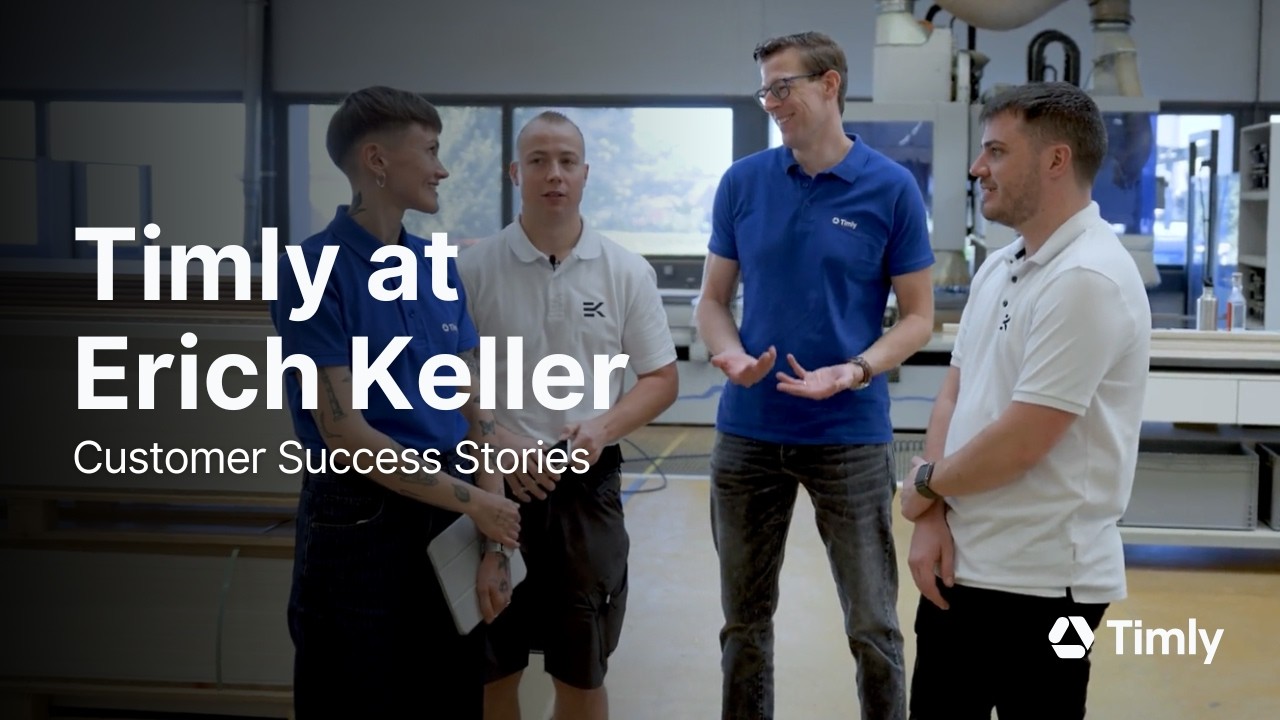
Company Overview

Erich Keller AG is a Swiss SME based in Sulgen, in the canton of Thurgau in eastern Switzerland. Originally rooted in the carpentry trade, the company has evolved significantly over the years. Today, Erich Keller operates in the fields of interior construction, workplace solutions, climate control systems, and modular room systems, including its own Talky room-in-room system.

All employees work at a single location. Across approximately 13,500 square meters of production and operational space, Erich Keller handles all planning and manufacturing in-house. To ensure projects move through production efficiently, meet high quality standards, and stay on schedule, the company needs a reliable overview of its machinery, equipment, operational resources, and the processes associated with them.

  • Headquarters: Sulgen, Switzerland
  • Employees: More than 150
  • Production and operational space: Approximately 13,500 m²
  • Business areas: Interior construction, workplace solutions, climate control systems, and modular room systems

The Challenge

Before implementing Timly, Erich Keller managed machinery, vehicles, testing equipment, and other operational resources separately across different departments, using numerous Excel spreadsheets. The information was generally available, but scattered across different files and areas of responsibility. As the company grew and the number of operational resources increased, this increasingly became a problem:

  1. No centralized overview: Machine data, equipment, operational resources, and responsibilities were stored in different files. There was no up-to-date, consolidated overview.
  2. Dependence on individual employees: Important knowledge was tied to individual spreadsheets and the people responsible for maintaining them.
  3. Unclear equipment locations on job sites: Pallet trucks, in particular, were a major challenge. On installation sites, another trade might quickly need a piece of equipment, and suddenly it would be on a different floor.
  4. Time-consuming reporting: Since the 1990s, Erich Keller has been tracking environmental metrics such as machine operating hours, vehicle mileage, electricity consumption, and wastewater. Every year, the data had to be compiled from multiple Excel files.

The goal was therefore clear: bring all information together in one place without introducing yet another standalone solution for each department.

The Solution

Erich Keller first learned about Timly through Fehr Braunwalder. After a Timly representative gave an on-site presentation, it quickly became clear that Timly was not another standalone solution for a single department, but a central platform capable of managing a wide range of assets and processes.

Today, approximately 1,300 assets are registered in Timly. The range is deliberately broad:

  • Production & Engineering: Stationary production machinery, equipment, testing devices, and tools
  • Transportation & Logistics: Vehicles, material handling equipment such as pallet trucks, and lifting equipment
  • Facilities & Administration: Buildings, keys, and areas of responsibility
  • Employee Equipment: Workwear and first aid supplies

Today, Timly is used by installation technicians, the purchasing department, production department managers, and warehouse staff, each with their own requirements. Installation technicians need quick access to equipment, while department managers and purchasing staff rely on a comprehensive overview and efficient management.

Checking out shared tools with employee badges: When an installation technician needs tools for a job site, they assign them to themselves at a tablet station using their personal employee badge and confirm receipt. This makes it immediately visible to everyone who is currently using the tools and which job site they are assigned to.

Environmental metrics from a single data source: Machine operating hours, vehicle mileage, electricity consumption, and wastewater figures are continuously maintained in Timly. At the beginning of each year, the data for the environmental report can be retrieved directly from Timly instead of being collected from multiple Excel files.

A collaborative partnership: Erich Keller discusses requests and suggestions for improvement directly with the Timly team and sees that its feedback is taken seriously and implemented. After all, software needs to evolve alongside the requirements of everyday operations.

The Results

With Timly, Erich Keller has replaced scattered Excel spreadsheets with a central platform accessible to all departments:

  1. Complete transparency: Approximately 1,300 assets from a wide range of areas are registered in one central platform.
  2. Clear responsibilities: It is easy to see what information belongs to each asset and who is responsible for each area.
  3. Better team coordination: Installation technicians can see which colleague has which tools and coordinate directly with one another.
  4. Timely restocking: Employees responsible for supplies can immediately identify when a service case needs replenishing.
  5. Reduced dependence on individuals: Knowledge is no longer tied to individual spreadsheets or employees.
  6. A solid foundation for reporting: Centralized data makes asset management and future reporting easier.

Erich Keller sees the first major real-world test in its environmental metrics. At the turn of the year, the company will retrieve this data directly from Timly for the first time. It expects this to deliver significant benefits and measurable value.

Key Takeaways

The Erich Keller example shows how a manufacturing SME can use Timly to bring together very different areas, from production machinery and pallet trucks to building keys, in a single system.

A central platform instead of countless individual spreadsheets creates transparency for all user groups. Installation technicians can quickly find what they need, while department managers and purchasing staff maintain an overview. Simple assignment using personal employee badges also ensures accountability, even when tools move between constantly changing job sites.

At the same time, the centralized data becomes valuable far beyond inventory management, for example, when preparing annual environmental reports. And the more departments and processes are integrated, the more valuable the centralized overview becomes.

Erich Keller is therefore continually exploring which additional processes could benefit from being managed in Timly. The goal is not to digitize as much as possible, but to keep expanding where doing so creates tangible value in day-to-day operations.