Only 21 %
of companies have a mature AI governance model, even though 46% consider governance one of their biggest risks.

39 %
of organizations report a measurable impact of AI on EBIT.

55 %
of Chief Supply Chain Officers cannot clearly quantify the ROI of their AI investments.

USD 407.9 million
in inventory write-downs at Zillow following algorithm-driven real estate purchases.

> 40 %
of agentic AI projects are expected to be discontinued by the end of 2027.

HUMAN-IN-THE-LOOP

A Checkpoint Builds Trust Simply by Being There

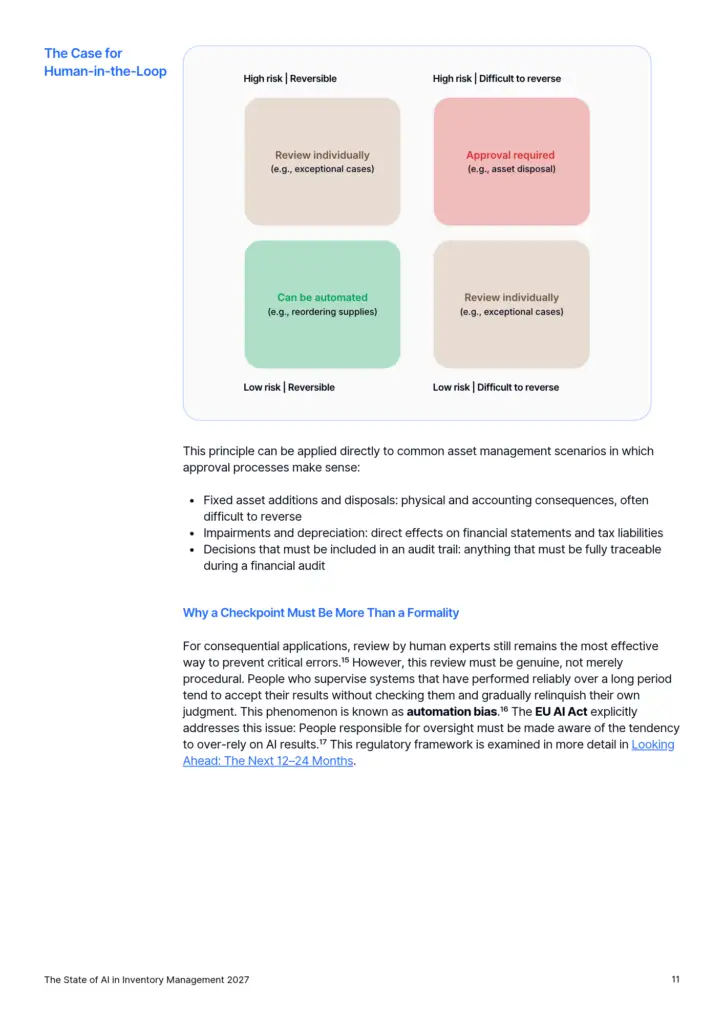
At Zara, an optimization model calculates deliveries to more than 1,500 stores. A team of around 60 employees could manually override any recommendation, but after a short trial period, they rarely did. Simply having that option in place was enough to build trust in the system. In inventory management, reordering consumables is a similar low-risk, easily reversible process that lends itself well to automation. By contrast, asset valuations, write-offs, and disposals affect financial statements and audit outcomes, making a clearly defined approval checkpoint essential.

What to Expect in the Report

  • The Current State: How advanced are inventory forecasting, image recognition, and anomaly detection in asset management today?

  • The Automation Trap: Three key risk areas, from legacy system integration and inaccurate valuations to unclear accountability.

  • Decision Framework: How to classify asset management decisions by risk and reversibility and establish targeted approval checkpoints.

  • A 12–24-Month Outlook: Which use cases are moving beyond the pilot stage and what role the EU AI Act and ISO/IEC 42001 will play.

  • Practical Recommendations & Real-World Examples: Five actionable steps and how Timly AI presents every data change for approval before execution.

When Does Your Approval Become a Mere Formality?

Over time, repeated exposure to reliable systems can lead people to accept their outputs without questioning them. This report shows you how to prevent automation bias through clear accountability, transparent data sources, and documented approval for every consequential decision.